
AI & Automation | Ask the Archive
Search every project you’ve ever done, in seconds.
Ask your project archive a question in plain English. Get a cited answer in seconds.
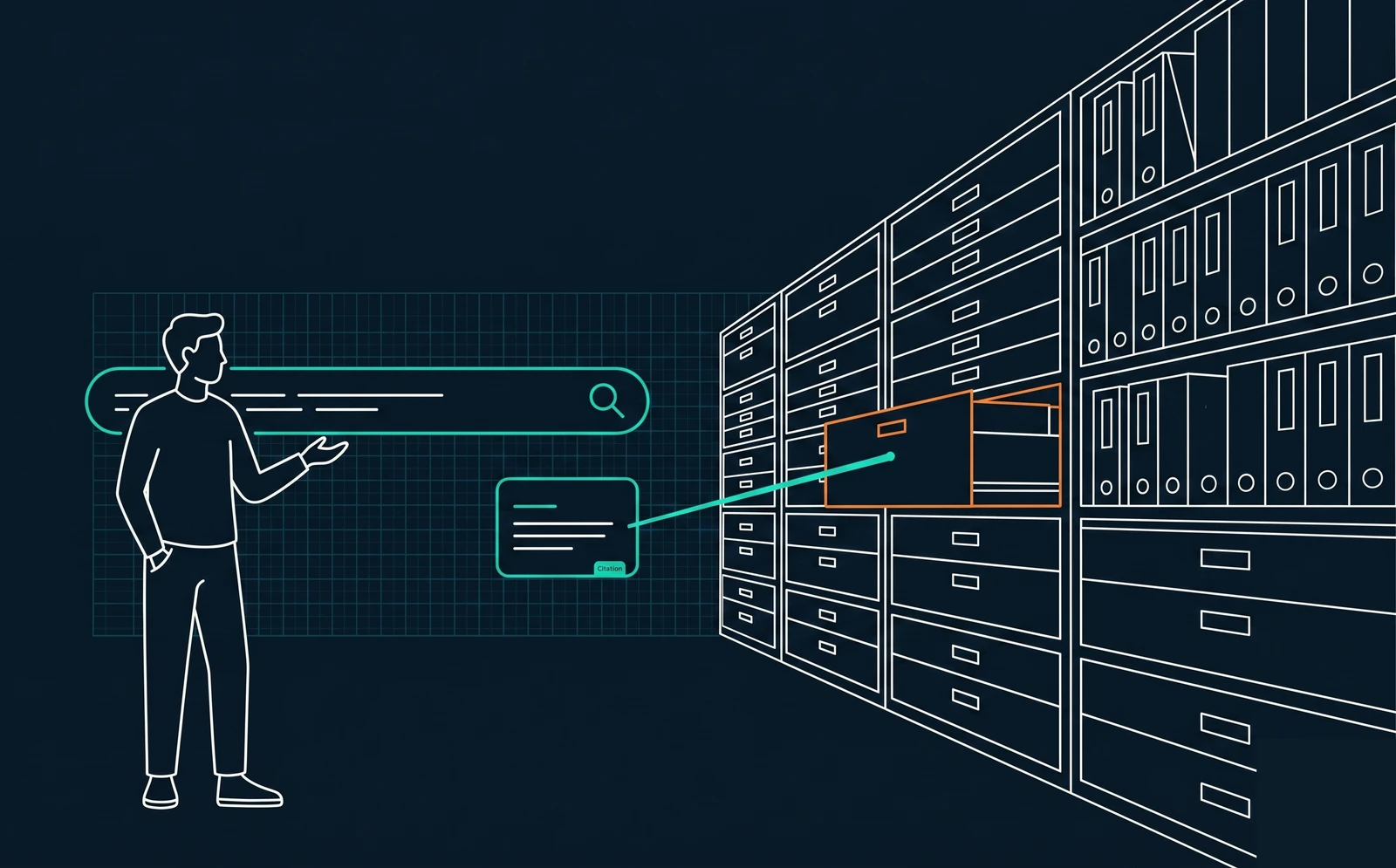
Ask the Archive indexes your project folders, contracts, and communications, so your team can mine years of work without hunting through folders or interrupting colleagues. It runs on your own network, respects your existing permissions, and cites every answer back to the source file.
The platform some teams know as Retrieval-Augmented Generation (RAG)
77%
of AEC firms miss deadlines because project information is hard to find. (Newforma, 2025)
37%
say document management is their single biggest operational challenge.
~60%
of an A&E team’s workday goes to hunting for information across files and email. (Monograph)
20–30 hrs
a week returned to a principal at a 45-person firm with what we built for her.
The AIA has put it plainly: an enormous amount of what experienced architects know cannot be written down, put in a manual, or captured in software. It lives in their heads. As senior people retire, that knowledge walks out the door. Ask the Archive keeps it searchable for the rest of the team.
The Problem
Your Best Answers Are Buried in a Decade of Files
File servers are great at storing information, and terrible at retrieving it. The people who remember where things live retire, change jobs, or simply forget. Every question becomes a tax on someone’s calendar.
Tribal knowledge walks out the door
When a senior team member leaves, they take the memory of where the good RFI language lives, which detail worked on the tricky assembly, and which subcontractor flagged an issue five years ago.
Windows search is a glorified filename list
Searching by keyword brings back a wall of documents. You’re still the one opening them one by one, guessing which paragraph actually answers your question.
The same work gets done twice
Teams rewrite contract clauses, scopes, and specifications that already exist somewhere on the server. Nobody has time to go find them, so the clock starts from scratch.
Consumer AI is a data leak waiting to happen
Pointing a personal ChatGPT or Claude subscription at your project data is easy and dangerous. Client information ends up on public servers, outside your control and your liability policy.
How It Works
A Research Assistant That Has Actually Read Your Files
Retrieval-Augmented Generation combines enterprise-grade AI with your own data. Instead of relying on what a public model happened to learn on the internet, it searches inside your documents, retrieves the specific passages that matter, and drafts an answer that cites exactly where each piece came from.
Index your data
We point the system at the project folders, document management systems, and communications archives you choose, and stop there.
Ask in plain language
Your team asks natural-language questions through a private web interface. No new search syntax, no new app to learn.
Retrieve with citations
The system pulls the relevant excerpts from your documents and uses a commercial AI model to compose a clear, cited answer.
Verify at the source
Every answer links back to the original file. Click through, read the context, and use the draft as a starting point, never as a final sign-off.
What It Looks Like in Practice
Questions Your Team Already Asks, Answered in Seconds
A RAG system earns its keep the moment someone stops walking to a colleague’s desk.
› Which projects had curtain wall water vapor issues, and how were they resolved?
Returns the three historical projects, the specific RFIs and change orders involved, and links to the resolved details, with source citations.
› Draft an RFI response in our usual voice, based on similar responses we’ve written before.
Produces a draft built from your own past language and formatting conventions. Your team reviews, edits, and sends. The AI never hits “send”.
› Pull the change order language from the hospital project that covered phased occupancy.
Surfaces the clause, the project it came from, and adjacent language used in similar contracts, ready to adapt rather than rewrite from scratch.
› Summarize every outstanding item from the last 90 days of correspondence on this project.
Produces a dated, cited summary so new team members can ramp up on a project in an afternoon instead of a week.
What You Get
The Upside of Treating Your Archive Like an Asset
A well-implemented RAG system changes what a small team can do in a day.
Mine Your Own Data
Natural-language search across contracts, RFIs, specifications, meeting notes, and email threads, cited to the source document every time.
Drafts in Your Voice
Generate first-pass site instructions, RFI responses, and change orders built from your firm’s own historical language and formatting.
Keep Tribal Knowledge
When experienced staff move on, the answers they used to hold in their heads stay accessible to the rest of the team.
Hours Back Per Person Per Week
Early adopters report saving 20–30 hours a week on document hunting, drafting, and cross-referencing, time that goes back into design and client work.
Catch Errors Before They Matter
Consistency checks across thousands of documents flag misspelled names, mismatched dates, and drifting numbers before they become contractual problems.
A Differentiator for Clients
Once it’s working, this becomes part of how your firm delivers: faster turnarounds, tighter quality control, and fewer things missed.
Security & Governance
Built With Guardrails From Day One
“Whatever AI can do for you, it can do to you.”
A platform like this only works if security and permissions are designed in from the start, not bolted on after an incident.
Runs on Your Infrastructure
The retrieval system runs on your own server or private cloud. Your documents stay inside your environment. They’re never uploaded to a consumer AI subscription.
Permissions That Match Your Org
Retrieval is tied to your identity provider. If a team member can’t open a folder in the file system, the AI can’t pull from it either. Financial and HR data stay segregated.
Enterprise-Grade AI, Not Consumer Tools
We integrate with commercial API tiers that come with business-grade data handling terms, not the consumer products designed for public use.
Humans Stay in the Loop
The system produces drafts. It does not auto-send emails, file RFIs, or stamp drawings. A qualified person always reviews before anything leaves your office.
How We Engage
A Pilot-First, Low-Risk Rollout
We don’t recommend a firm-wide rollout on day one. We recommend proving value on a real project, tuning what works, then expanding from a position of evidence.
Scoping & folder assessment
We review the target project’s folder structure, flag anything that needs to be sanitized or excluded, and align on the questions your team most wants answered.
Secure environment setup
We stand up a private virtual machine inside your existing infrastructure and wire it into your identity provider. No third-party cloud storage of your documents.
Index, tune, and roll out to a small team
We index the pilot project, train the system on your firm’s conventions, and give a small user group a private web interface. You run real questions through it for four to six weeks.
Measure, refine, and decide what’s next
We review accuracy, time savings, and edge cases with your team. Together we decide what to expand to next: more projects, more data sources, or additional drafting workflows.
Broader rollout, grounded in evidence
Once the pilot proves itself, we extend the system to more projects and more teams, with permissions, training, and governance scaled alongside it.
A note on industries. We work extensively with design and construction firms, where the document-heavy, contractually driven nature of the work makes RAG an especially powerful fit. The same approach applies to any organization sitting on years of project archives, contracts, or case files: professional services, legal, and beyond.
Stop searching. Start asking.
If your firm is sitting on years of project work and losing hours a week trying to find what’s in it, RAG is the next step. Start with a scoped pilot on one real project and see what it does.