
News & Insights | June 24, 2025
Blueprint for Success: Why Architecture Firms Need an IT Strategy
For architecture firms, technology has quietly become a competitive variable. Here is why a real IT strategy, rather than reactive break-fix support, increasingly decides which firms win work and which fall behind.
By Resolved Team
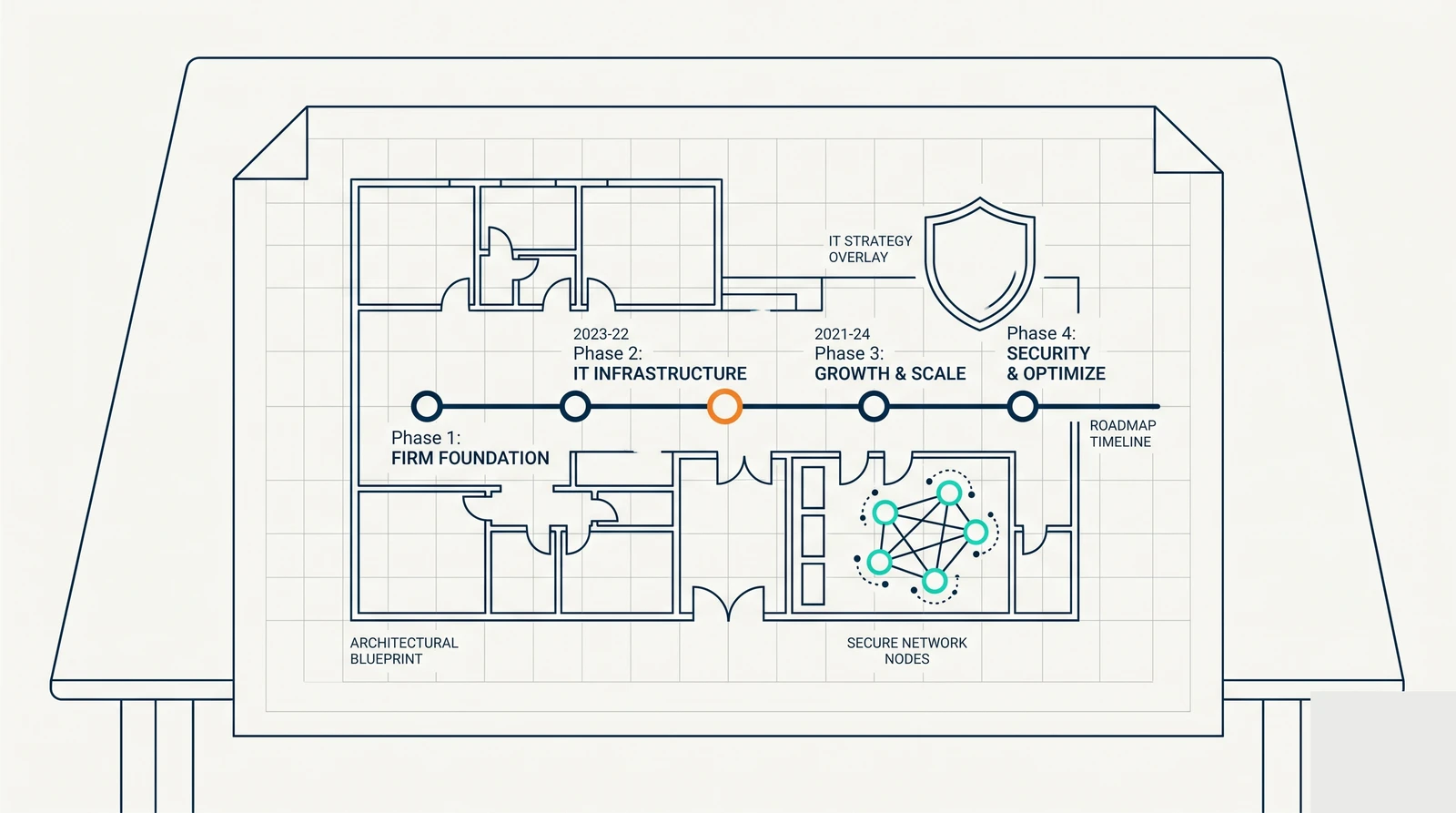
No architect would let a building go up without a set of drawings. Yet most architecture firms run their entire technology environment with nothing that resembles a plan. A server gets replaced when the old one fails. Software gets added when someone asks for it. Security gets attention the week after a scare. It works, right up until it doesn’t, and by then the cost has already been paid: in missed deadlines, in billable hours that quietly leaked away, in a pursuit that went to a faster competitor.
Technology used to be a back-office line item for an architecture firm. It is now a variable that decides whether you hit deadlines, protect your margins, and win the next project. The firms pulling ahead treat IT as a strategy tied to the business, not a series of repairs. Here is what that shift means, what the absence of a plan actually costs, and what a real strategy looks like for a firm like yours.
The work changed. The stakes changed with it.
A decade ago an architecture firm’s technology needs were modest: email, a file server, a handful of licenses. The work has outgrown that picture. Revit models and BIM coordination push workstations and networks hard. A single project can carry hundreds of gigabytes of files, and ten years of projects can reach hundreds of terabytes you are obligated to keep. Teams now collaborate across offices, consultants, and home setups. Clients expect faster turnarounds every year.
Every one of those shifts raises what technology can do for you, and what it costs you when it is wrong. The distance between a firm with a plan and a firm without one widens a little more each year.
What “no strategy” actually costs
The absence of a strategy rarely arrives as a single dramatic failure. It shows up as a slow tax on the business.
- Billable time, lost quietly. When a model takes too long to open, a file is hard to find, or support takes hours to answer, the bill is paid in billable hours that never get billed. Research puts the scale at around 60% of an architecture and engineering team’s workday spent hunting for information across files, drives, and email threads (Monograph). That is not a rounding error. That is capacity you already paid for.
- Deadlines you should have hit. 77% of AEC firms report missing deadlines because project information is hard to find (Newforma, 2025). A missed deadline is reputation spent.
- Risk you cannot see. Client data and design IP end up scattered across personal drives, aging servers, and inboxes. Without a plan for how data is organized, secured, and backed up, a single ransomware event or one departing employee can do lasting damage.
- Decisions made under pressure. With no roadmap, every technology choice is made reactively, at the worst possible moment, and usually at a premium.
None of these is fatal on its own. Together, year over year, they are the difference between a firm that compounds and a firm that treads water.
What a real IT strategy looks like for an architecture firm
A strategy is not a stack of products. It is a short list of decisions, made deliberately and revisited as the firm grows. For an architecture practice, five pillars carry most of the weight.
- Infrastructure built for how you actually work. Workstations, network, and storage sized for Revit, large models, and the file volumes your projects generate, whether that lives on-premises, in the cloud, or across both.
- Data you can find. A clear structure for where project files live, how they are named, and how they are archived, so the detail from a job three years ago takes seconds to surface instead of an afternoon.
- Security that fits AEC. Protection matched to the way your firm actually shares files with consultants and clients, backed by the policies, training, and tested backups that turn a would-be disaster into a non-event.
- A roadmap and a budget. A multi-year view of what gets replaced, what gets added, and what it costs, tied to your growth plans, so technology spend becomes predictable instead of a string of surprises.
- AI readiness. A clear point of view on where AI fits your firm, and the data and security foundation that lets you adopt it safely when you are ready.
Strategy is what makes AI safe
That last pillar deserves its own line, because it is where the next few years will be decided. AI is moving from novelty to advantage in design and engineering work. But AI is only as useful as the data it can reach, and only as safe as the environment it runs in. A firm with scattered files and thin security cannot adopt it responsibly, however much it wants to. A firm with its data organized and its security sound can move quickly and with confidence.
The strategy you put in place today is the foundation that any AI advantage will stand on. Get the foundation right first. Then build on it.
A discipline, not a document
The firms that get the most from technology do not write a strategy once and file it away. They treat it as a standing conversation: a regular review of what is working, what is coming, and what the next investment should be, led by someone who understands both the technology and the business of running an architecture firm. That role, a strategic technology lead or Fractional CIO, is what separates a plan that lives and adapts from one that gathers dust in a drawer.
The blueprint your technology has been missing
At Resolved, this is our entire focus. We work with architecture, engineering, and construction firms, and we begin every relationship the same way: with a Strategic Technology Assessment that maps where you stand, what is at risk, and what the next few years should look like, complete with a clear roadmap and a budget to match.
If you are ready to stop reacting and start planning, that assessment is the place to begin. It is, quite literally, the blueprint your technology has been missing.
News & Insights
All insights